
2025 in Review


The following is a lightly redacted version of the year-end letter we sent to our investors and friends of the company. We’re sharing this to help our readers understand how we think about Rowan, what we’ve been working on this past year, and what we’re planning to do next. As we begin our third year of business, we’re more excited than ever about what we’re building and where Rowan is going—thanks for following along!
Merry Christmas and Happy New Year!
Here at Rowan, we’ve been reflecting on how much we’ve learned over the course of 2025. We originally envisioned Rowan as building modern software for high-accuracy quantum chemical simulations. In our letter last year, we wrote about how we’d started building workflows around quantum chemistry to make it easy for any scientist to apply validated state-of-the-art techniques to their problem of interest.
As we’ve continued to work in this space, we’ve realized that the opportunity for new computational software is much bigger than we thought. Scientists aren’t just looking for better quantum chemistry tools: they need better design and simulation across all areas of chemistry. Existing scientific software is often expensive, unreliable, or just badly written, which makes it difficult for the end user to actually do the research they want to do (be it drug discovery, materials science, or agrochemistry). Furthermore, the deluge of new promising ML methods has overwhelmed even the best scientific teams. When new models come out almost every week, how can busy scientists find the time to figure out what’s worth using?
Rowan aims to solve these problems by building excellent software tools for the modern scientific era. As we wrote earlier this year, we’re trying to build “a Ford Taurus for computational chemistry”—software that’s easy-to-use, trustworthy, reliable, and affordable. Increasingly, scientists and scientific teams are using Rowan not only because they like various features we have but because they trust us to work with them and solve their problems, build quality software, and care about the end user. Working with Rowan lets scientists stop worrying about their software and focus instead on their actual scientific problems, which is good for them and good for the world. (You can read a few more of our thoughts on this topic here and here.)
Our product has come a long way in 2025. Here are just a few of the things we shipped:
We launched an entire suite of structure-based drug design tools, including protein–ligand docking, AlphaFold-style co-folding (Boltz-1, Boltz-2, & Chai-1), molecular dynamics, and generative protein design.
We significantly enhanced our simulation capabilities: we released our own neural network potential (Egret-1), NNPs from external groups (like the OMol25 and UMA models from Meta), next-generation semiempirical quantum chemistry code (g-xTB), and GPU-accelerated quantum chemistry (GPU4PySCF). We also published a website that makes it easy to compare different methods and find the best one for a given task (benchmarks.rowansci.com).
And we added a large variety of physics- and ML-powered property-prediction workflows: solubility, hydrogen-bond strength, macroscopic acidity, blood–brain-barrier permeability, and more.
Of course, none of these features matter if scientists aren’t using them—and we’ve been happy to see significantly increased usage on Rowan this year. We now have over 8000 users; monthly active users have increased over 7x from last year, and the number of calculations run is up 19x.
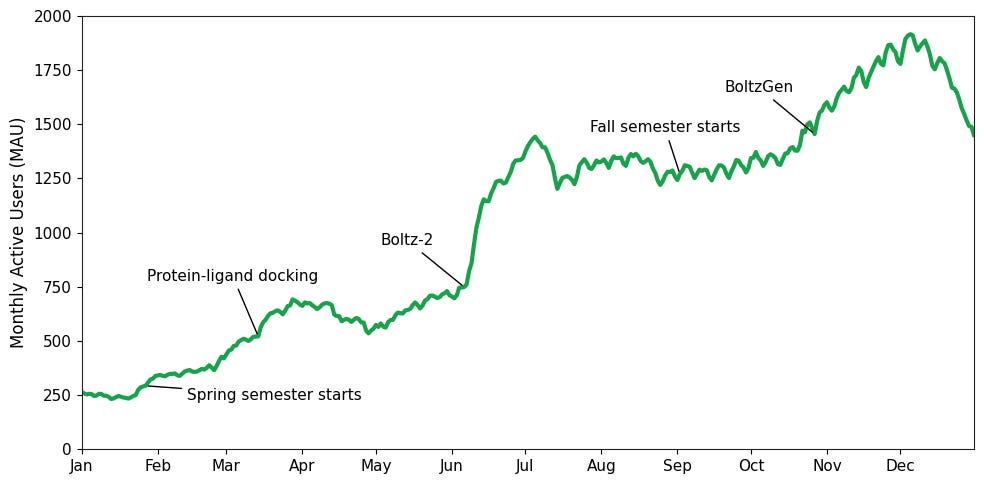
A majority of this growth is organic, but we’re also always happy to tell people about what we’re doing. Our team presented at a variety of conferences this year, including Bio-IT World, Meta’s open-source AI conference, the Ligo/FutureHouse AI x Bio unconference, the computer-assisted-drug-design Gordon Research Conference, and the 2025 Progress Conference; and we spoke or gave talks at Harvard, ETH Zurich, Cambridge, Copenhagen University, Michigan State, the University of Bonn, Hope, and Calvin. For those we couldn’t meet in person, we released six preprints & one journal article (and Rowan’s tools were cited in many more papers). We were also happy to be highlighted by Forbes in their 2025 30 Under 30 Science list.
We launched subscription plans for Rowan at the end of last year. Some of the customers and partners we’re allowed to talk about publicly are:
Ligo Biosciences, who are using ML to design new enzymes
Until Labs, a company building reversible human organ cryopreservation technology.
And bioArena, a company using Rowan’s tools to test scientific capabilities of frontier LLMs.
You can see quotes and testimonials from these and others on our website.
Looking forward to 2026, we’re excited about:
Building out the infrastructure and features to support massively scalable virtual screening workfloads—running calculations on millions of molecules at once.
Powering “AI scientists” with Rowan’s existing suite of scientific tools. We’ve seen early success with AI agents using Rowan to understand chemistry better, and we think that Rowan’s tools are an ideal complement to existing agentic AI systems. (You can read more of our thoughts on AI scientists here.)
Releasing a free-energy perturbation (FEP) workflow to predict protein–ligand binding affinity. FEP is the “gold standard” for computational structure-based drug design and has long been the key feature for legacy competitors.
We’re grateful for your continued support, and we are very excited about what’s next for Rowan. Happy new year!
Corin