


Today, Rowan is launching virtual screening as a service in partnership with onepot. Our offering combines high-throughput in silico screening and simulation, experimental compound synthesis, and wet-lab assay validation. A program that traditionally takes months can now move from target hypothesis to synthesized, experimentally tested compounds in weeks, accelerating DMTA cycles and enabling faster decision-making.
Virtual screening has historically forced a tradeoff between scale, computational rigor, and turnaround time. Searching very large chemical spaces is expensive; applying higher-fidelity methods to promising molecules is slower still; and synthesis and experimental validation introduce another set of logistical bottlenecks. Rowan has spent years building the computational infrastructure required to eliminate much of that tradeoff, and we’ve seen the impact that our science can have on real-world programs. Now, we’re offering our entire optimized virtual-screening pipeline as a service so that customers can benefit from modern computational tooling without having to run the simulations themselves.
Rather than applying a single scoring function to an enumerated library, Rowan progressively searches chemical space using increasingly expensive computational methods. We begin with billion-scale library search, preserving both predicted quality and chemical diversity as the search narrows. Promising molecules then pass through additional structure- and property-based models, increasingly rigorous docking and rescoring, and physics-based simulation. Each stage is designed to spend computation where it is most informative, allowing us to reduce billions of possible compounds to a small, diverse set of candidates for synthesis in a matter of days.
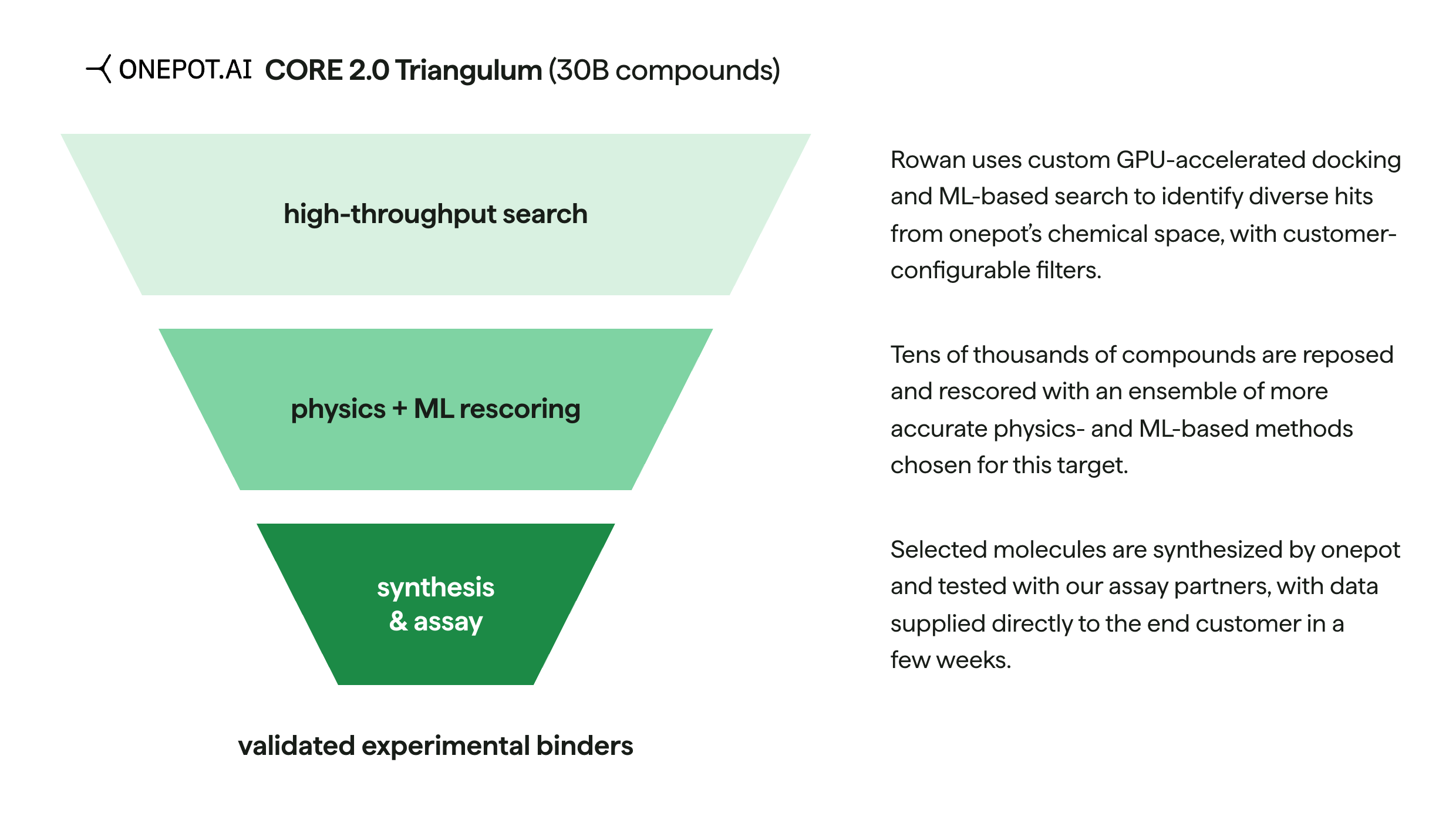
Computation alone can only go so far, however, which is why we’re excited to be partnering with onepot for lightning-fast compound synthesis. onepot’s new CORE 2.0 Triangulum library contains over 30B diverse molecules that can be synthesized and delivered within 5-7 business days. Here’s what onepot CEO Daniil Boiko has to say:
For a long time, you could screen billions of molecules computationally, but that didn’t mean very much if you couldn’t actually make them. What’s exciting now is that Rowan can search a huge chemical space and onepot can turn the interesting results into physical compounds in days. When the virtual and experimental parts of drug discovery happen at the same speed, a lot of things become possible that just weren’t practical before.
Every drug-discovery program is uniquely complicated in its own way, which is why we’re offering this as a hands-on offering and not a one-size-fits-all product. Rowan designs each screen around the actual constraints of the program, incorporating existing experimental data, cross-target selectivity, custom assays, synthetic constraints, patent restrictions, and other project-specific requirements.
We’re also working with assay providers to provide options for integrated compound testing. If commercial assays exist for your target, we can directly coordinate testing of onepot-synthesized molecules with vendors; if not, we’re happy to send molecules directly to your lab for in-house testing.
Interested in working with Rowan? We’ll evaluate your target, available structural data, assay requirements, and relevant chemical space and propose a screening strategy at no cost. Contact us here to discuss if Rowan’s virtual screening is right for your team.
The handoff from progressively filtered candidates to synthesis seems like an opportunity to preserve an audit trail of exclusions as well as winners. For each stage, I would keep the score version, applicability checks, uncertainty and the reason a molecule was removed, then reserve a small experimental control set of chemically diverse candidates that were not top-ranked. Otherwise, an apparently successful shortlist tells us little about systematic false negatives upstream.
What validation set would distinguish a stronger screening pipeline from a narrower one that simply discarded difficult chemistries? I would measure shortlist success separately from the exclusion audit: chemically diverse controls can expose an upstream blind spot even when the top-ranked candidates perform well.