
Today at Rowan we’re launching a number of improvements to our free-energy-perturbation workflow, including a new charge scheme (RESP), a new ligand-parameterization method (Mango), and the ability to include additional small-molecule cofactors.
We’re also releasing updates to our electronic-properties workflow to show the natural transition orbitals (NTO) and transition densities from TDDFT. Finally, we’re releasing work studying whether LLMs can complete inverse folding tasks and refreshing our web platform’s design & adding dark mode.
Considerations in ligand forcefields
One of the key considerations in FEP is the small-molecule forcefield. Incorrect ligand forcefields lead to poor quantitative results. While protein and water forcefields are relatively standardized at this point, small-molecule forcefields remain an extensive active area of development. Figuring out how to represent an arbitrary small molecule as a series of bond, angle, dihedral, and non-bonded terms is challenging, and many different schemes have been explored:
Conventional forcefields like Amber, CHARMM, and OPLS work via atom typing. Each atom is assigned a discrete chemical type, and bond, angle, torsional, & non-bonded parameters are then obtained from tables indexed by combinations of these atom types.
OpenFF uses direct chemical perception. Rather than first assigning each atom to a global atom type, parameters are assigned directly by matching increasingly specific SMARTS/SMIRKS patterns to the molecule. This makes the parameter hierarchy easier to extend and avoids some of the combinatorial complexity of traditional atom typing.
Machine-learned approaches, exemplified by Espaloma and Grappa, instead predict molecular-mechanics parameters directly from the molecular graph using a graph neural network. This makes parameter assignment continuous with respect to chemical environment rather than forcing each atom or bond into a discrete category, and potentially allows much smoother interpolation across chemical space.
While bond and angle terms are pretty easy to get right, torsional energetics are often a major source of ligand forcefield error, because (1) torsions determine conformational populations and molecular “shape” and (2) torsion parameters must often implicitly account for electronic effects that are hard to represent in simple forcefield functional forms. Errors in non-bonded interactions are also important for FEP, since binding free energies depend on subtle differences in ligand–protein and ligand–solvent interactions.
Atom-centered partial charges are also needed to parameterize arbitrary small molecules, and different methods for determining partial charges can lead to surprisingly different results. The most-used method is AM1BCC, which uses a modification of the AM1 semiempirical method to quickly generate per-conformer partial charges, apply a correction, and average the charges over conformers to generate a final set of conformer-independent charges. AM1 is fast for a quantum chemical method but slow relative to other steps of forcefield parameterization, and consequently GNNs have been trained to replace AM1BCC for charge assignment; the newest OpenFF model, OpenFF Sage 2.3.0, uses AshGC/NAGL, a GNN trained to reproduce AM1BCC charges to accelerate ligand parameterization.
An alternative to AM1BCC and AshGC is RESP, a higher fidelity method for partial-charge assignment. To compute charges with RESP, a quantum-chemical calculation is first run to generate the spatial electrostatic potential. A grid of points near the molecule is generated and used to fit per-atom partial charges that best approximate the molecular electrostatic potential (subject to an overall regularization constraint). RESP generates optimal partial charges relative to the given QM level of theory, but is historically too slow for routine usage owing to the time needed for quantum-chemical calculations.
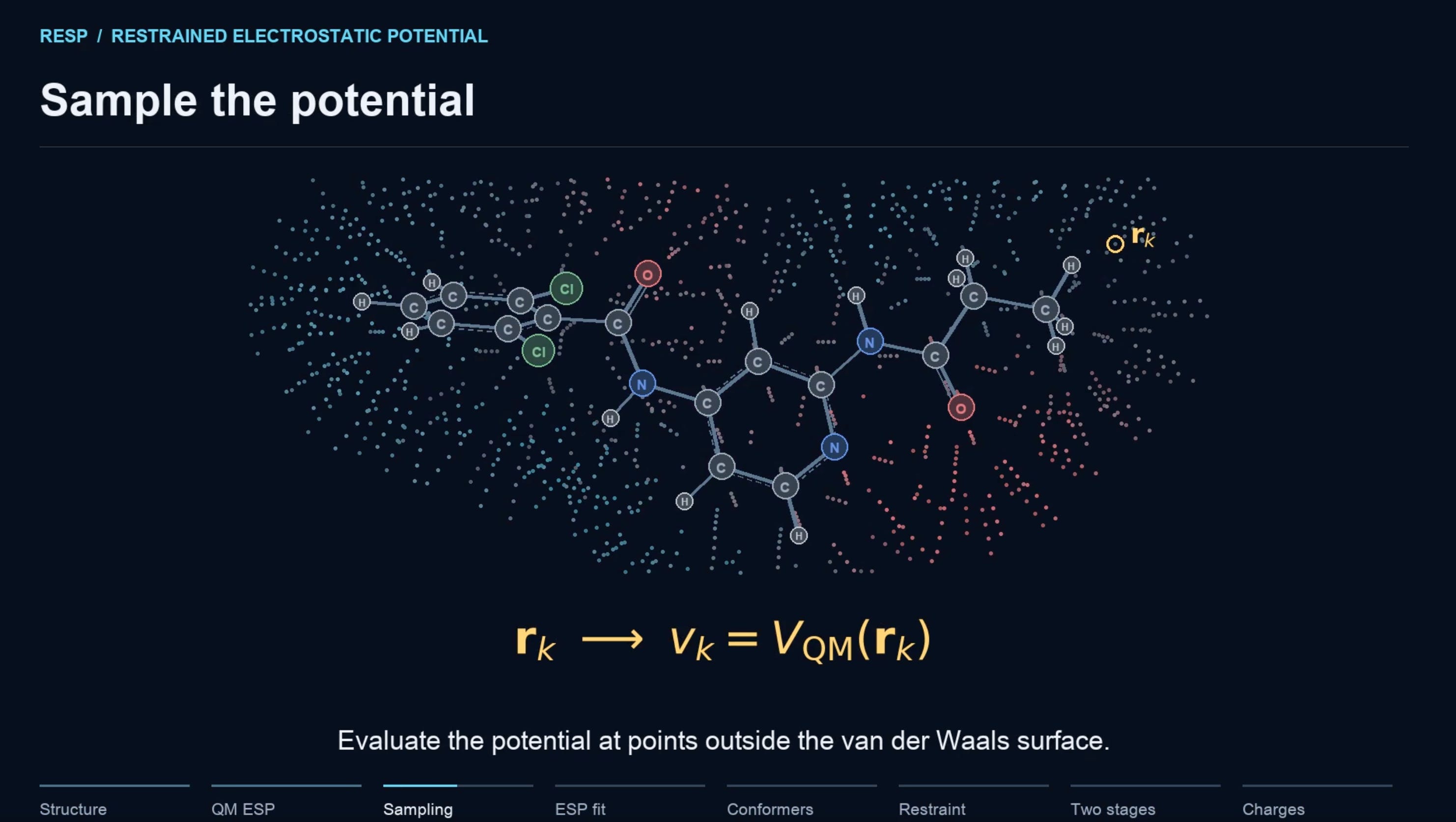
It’s worth noting that “better” charges don’t always lead to better RBFE results—forcefield parameters are optimized in tandem, and changing to “more physical” point charges could disrupt the balance of coupled parameters and lead to worse behaviors. Still, RESP-based charges are often anecdotally recommended as a way to improve FEP performance.
Mango, a new ligand-parameterization approach
We’ve been frustrated by the limitations of off-the-shelf ligand forcefields, and we set about trying to develop a better approach for RBFE calculations run through Rowan. While decades of effort have been expended on this problem to date, two new advances gave us hope:
The rise of accurate NNPs like UMA allows us to compute QM-quality potential-energy surfaces in just seconds.
Modern GPU-accelerated DFT programs also make it possible to generate QM-quality electrostatic potentials without spending hours of CPU time per ligand. (See recent work from Merz and coworkers.)
We envisioned that the combination of these two advances would allow us to refit forcefields around RESP-computed partial charges for each new small-molecule ligand. After considerable trial-and-error and iterative optimization, we’ve arrived at the following ligand-parameterization workflow, which we’re calling Mango:
We assign partial charges using the selected charge model. Mango supports NAGL, AM1BCC, and RESP partial charges. For RESP, we select a conformer ensemble, relax its geometries with UMA, and compute electrostatic potentials using GPU-accelerated Hartree–Fock calculations at the HF/def2-SV(P) level of theory. A two-stage multi-conformer RESP fit produces one charge set with exact total-charge and topological symmetry constraints.
Mango builds a Sage 2.3 forcefield using these charges and samples the ligand’s conformational landscape. By default, it generates up to 32 OpenConf candidates and selects up to 12 diverse starting conformers, retaining the supplied geometry first. UMA relaxes these structures to generate a set of diverse low-energy minima.
Mango supplements these minima with relaxed torsion scans. For each eligible acyclic heavy-atom single bond, Mango selects one representative proper dihedral and uses UMA to run a relaxed 8-point scan around that dihedral.
Mango jointly fits small additive torsion corrections to the difference between UMA and Sage energies. The fit uses cosine terms with periodicities 1–3 and compares relative energies within the minima ensemble and within each torsion scan: regularization favors small corrections, while coefficient bounds limit their magnitude. This fit is done atop the chosen partial-charge model so that the torsions are being fit around the chosen charges.
Mango exports the resulting molecular-mechanics parameters for downstream simulation. If sampling, reference evaluation, or numerical fitting encounters a handled failure, the Sage 2.3 baseline with the same charges is returned.
The output is a simple Amber/OpenFF-type forcefield which can easily be ingested by downstream MD or FEP calculations.
Mangos are small, agile hummingbirds: just like a mango has lightning-fast wingbeats and can quickly change direction, the Mango workflow lets Rowan bring modern neural-network potentials and quantum-chemical electrostatics into FEP workflows while retaining the lightning-fast simulation speed needed for cost-effective RBFE calculations.
Benchmarks
We tested Mango, with both the NAGL and RESP charge schemes, against the 8 FEP benchmark systems from Lingle Wang and co-workers. All runs used 390/400 local steps in TMD, and each leg was run for 4 ns to make comparisons more reliable (vs. Rowan’s default 2 ns).
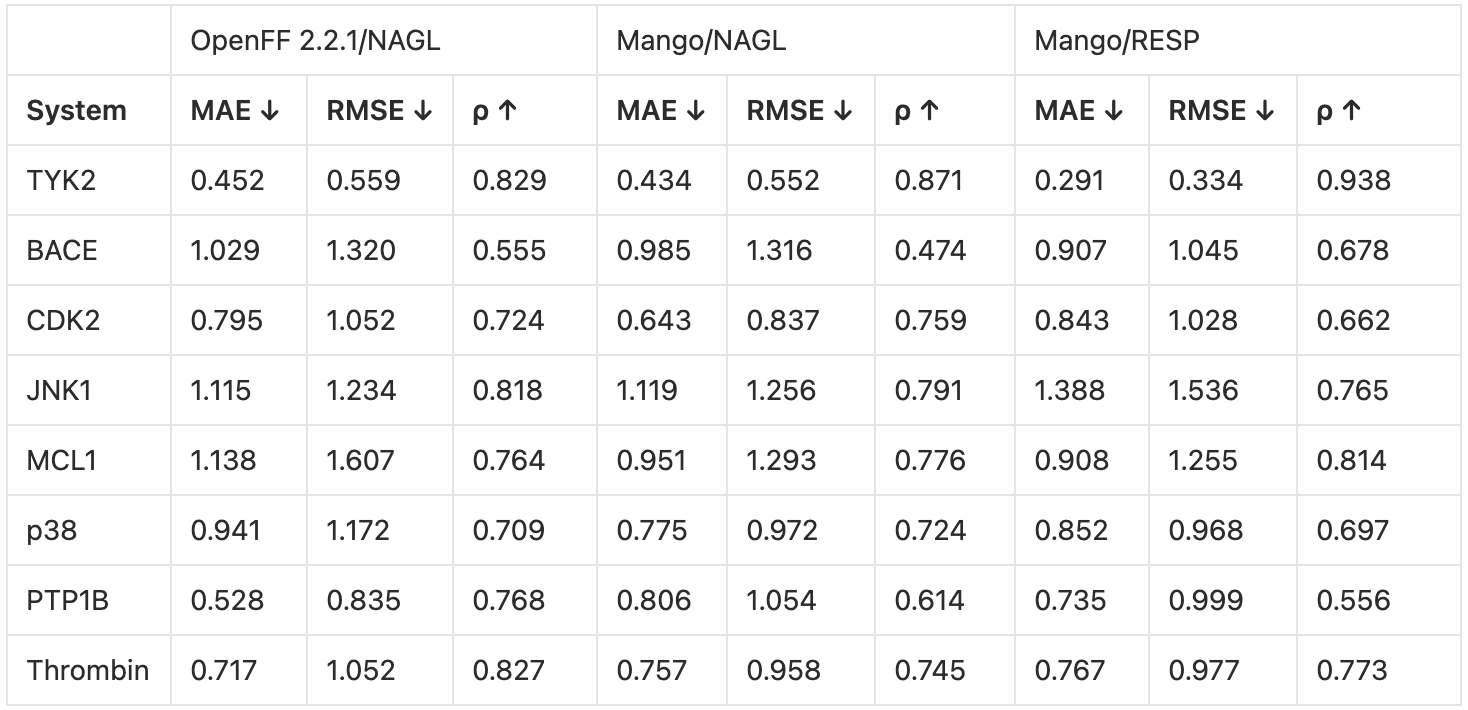
Breaking down the above results by system:
TYK2, the easiest system on the above benchmark, improves slightly after torsion refitting (Mango/NAGL) and dramatically when RESP charges are used. (The sensitivity of the TYK2 benchmark set to torsion refitting was previously observed by Blanco-Gonzalez and coworkers.)
BACE is minimally affected by torsion refitting—lower MAE, lower Spearman ρ—but is noticeably improved by RESP charges.
CDK2 is improved by torsion refitting, but RESP charges perform worse than NAGL charges.
JNK1 is roughly unaffected by torsion refitting, and significantly worse with RESP charges. The JNK1 ligands had optimization difficulties and often fell back to Sage 2.3 parameters, explaining the poor performance—we’re working on improving the reliability of this process.
MCL1 is dramatically helped by torsion refitting, and the charge scheme doesn’t make a big difference.
p38 is helped by torsion refitting, but RESP charges are deleterious.
PTP1B is not helped by torsion refitting or RESP charges.
Thrombin is not very affected; both Mango schemes give slightly better RMSE and slightly worse Spearman ρ.
Taken together, it seems that Mango refitting often improves energy accuracy, while having a less consistent impact on ranking. RESP charges sometimes produce substantial gains (TYK2, BACE) while sometimes giving worse performance (CDK2, JNK1); this is consistent with what we’ve already seen with AM1BCC and NAGL. As with other tunable RBFE parameters (graph construction, window length, local vs. global steps), we strongly recommend testing charge and forcefield parameters against your own dataset before extensive prospective usage of RBFE.
Limitations
Mango is a conservative first step towards improving RBFE forcefields. We’re explicitly not adjusting Lennard–Jones terms or doing anything fancy to improve the accuracy of protein–ligand interactions; we’re just computing charges differently and refitting torsions.
Still, we expect this to be impactful in many cases. Previous work from Exscientia found that simply refitting torsions gave comparable improvements to complex NNP-based endpoint-correction schemes, and we anticipate that Mango will similarly improve the reliability of Rowan’s RBFE workflow, particularly for unusual or exotic ligands.
We plan to explore more ambitious forcefield-related efforts in the future.
Small-molecule cofactors
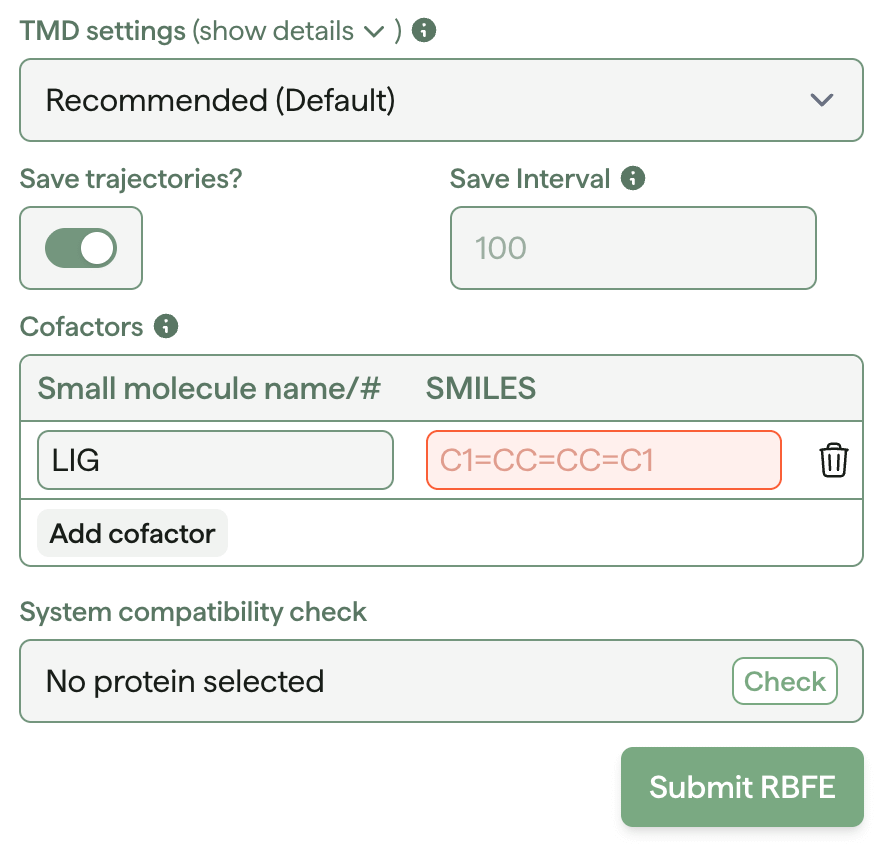
Rowan’s RBFE workflow now supports additional small-molecule ligands in the binding site, allowing for binding-affinity values to be computed for systems with cofactors like ATP/GTP. If your input receptor PDB contains cofactors, simply add the residue name and SMILES in the RBFE settings:
Natural-transition orbitals and transition densities
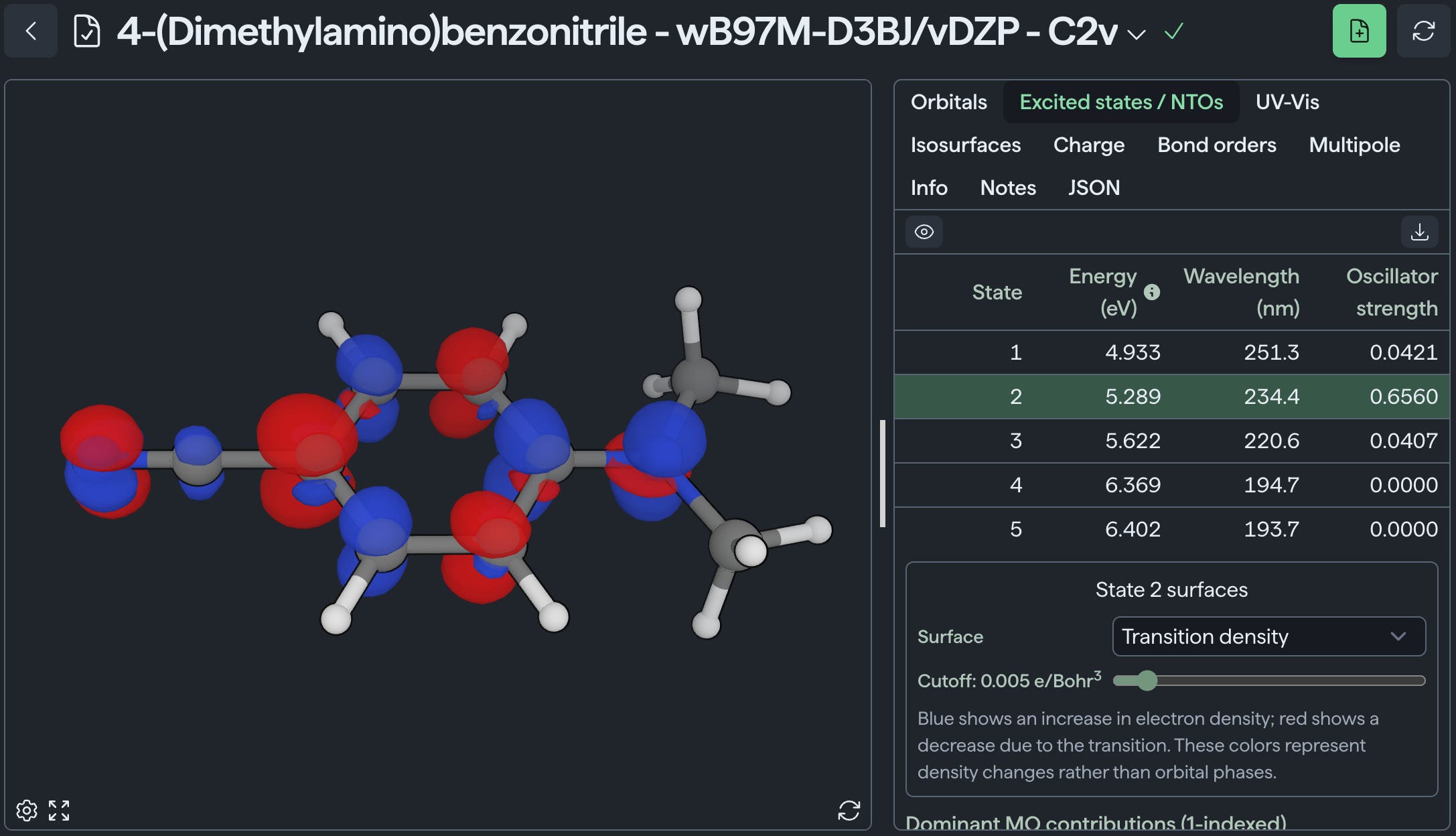
Natural transition orbitals (NTOs) and transition densities have been added to the electronic properties workflow. NTOs describe electronic excitations with a compact set of hole–particle pairs indicating where electrons left (hole) and where they were excited to (particle). NTOs are derived from a singular-value decomposition of the transition density matrix, and thus multiple hole–particle pairs can contribute significantly. NTO pairs with contributions below 5% are pruned to save space.
Support for NTOs and transition densities was added through GPU4PySCF, which now also supports molecular orbitals and other electronic properties, accelerating these calculations compared to the CPU-only calculations previously run through Psi4.
Inverse folding with LLMs
LLMs are becoming very capable at designing, orchestrating, and analyzing molecular design campaigns using external scientific tools. Recent work from Anthropic and muni has shown that LLM agents can successfully run binder-design workflows around specialized protein models, and we’ve seen similar unassisted LLM behavior for small-molecule optimization (see this post and this post with muni). It remains unclear, however, which scientific capabilities these models natively possess apart from external tools.
To directly probe this question, we tested frontier models at inverse folding: given an anonymized protein backbone and several example sequences, we asked LLMs to design additional diverse sequences that fold to give the original backbone. We found that models possess significant capabilities in this domain, with implications for agentic protein-design workflows—read Ishaan’s full post on our blog!
(Also, check out Ishaan’s post yesterday about daraxonrasib hydration sites.)
Design refresh & dark mode
We’ve refreshed our web platform to match April’s website redesign and added dark mode.
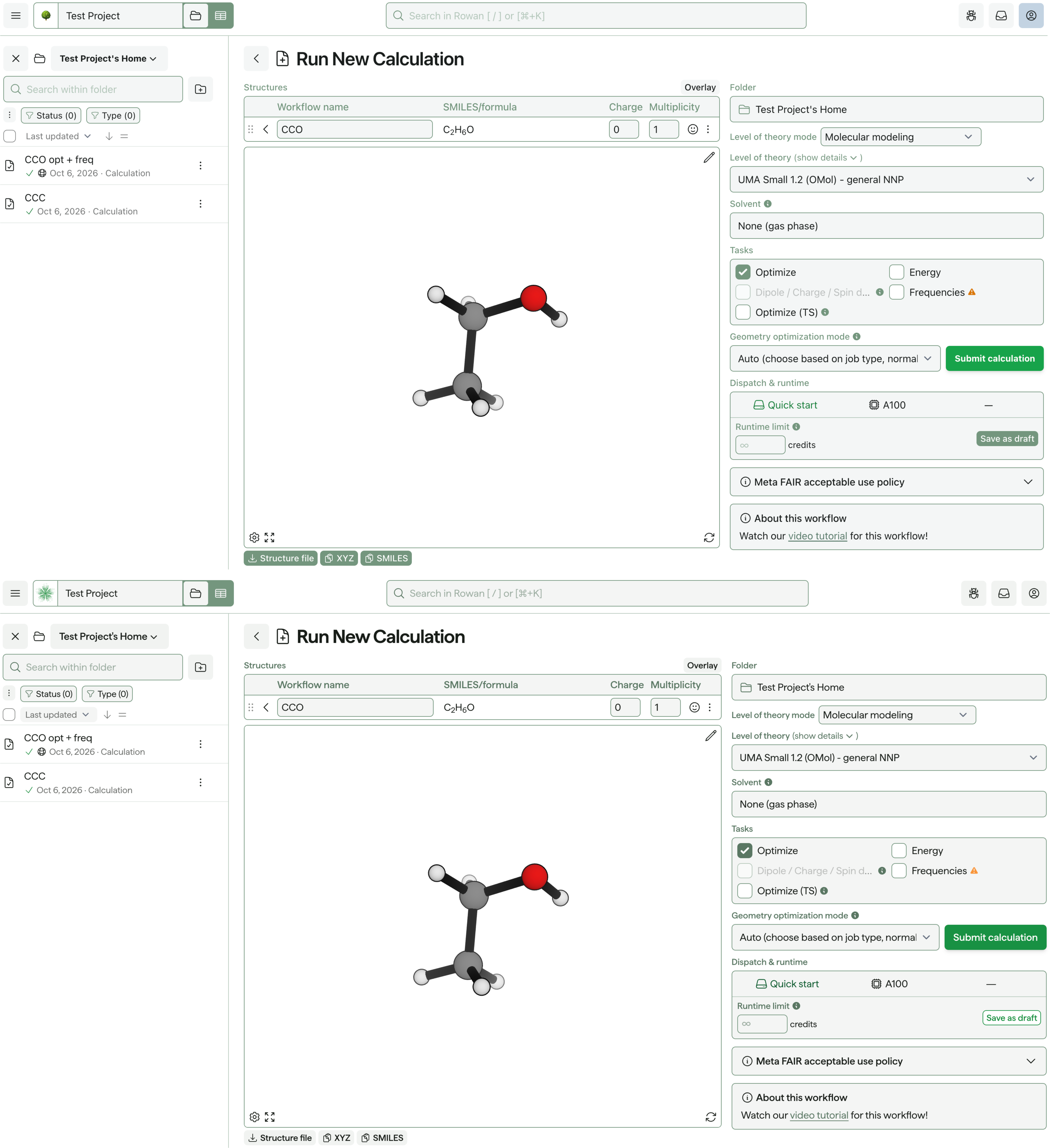
The changes include:
our new logo and the Matter typeface,
higher-contrast colors for better readability, and
a clearer hierarchy between primary actions like “Submit,” secondary actions like “Save as draft,” and controls like “Export.”
We’ve also added the much-requested dark mode!
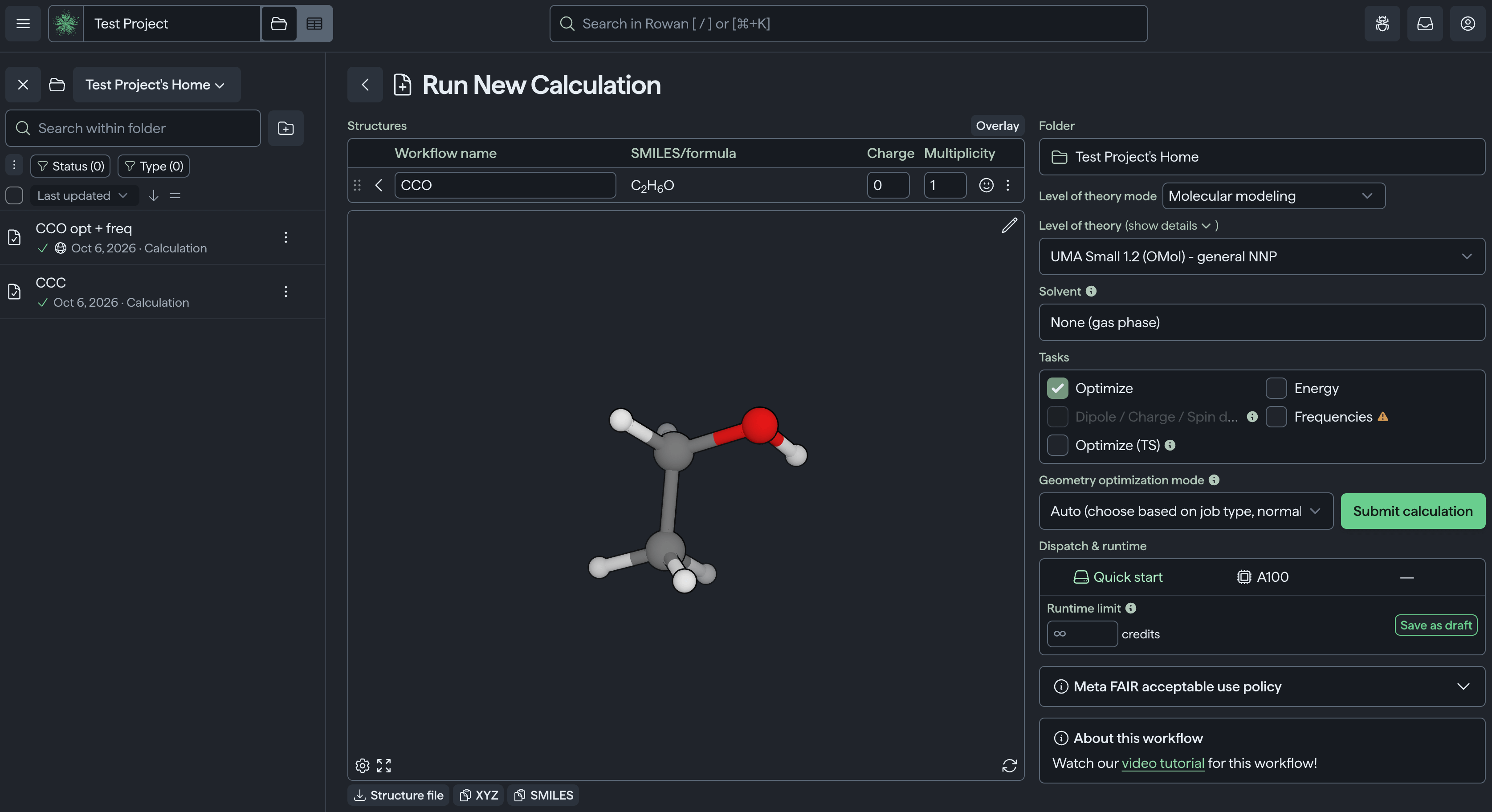
Use “Appearance” in the account settings dropdown to choose light, dark, or system: