
NMR Spectroscopy
the importance of NMR spectroscopy; the languorousness typical of state-of-the-art methods; MagNET, a new model, and its Rowan workflow; testimonials and case studies; new agent benchmarks



We’re excited to launch Rowan’s nuclear-magnetic-resonance (NMR) workflow, which uses the new MagNET ML model to predict 1H and 13C NMR spectra. This workflow is the result of a multi-year collaboration with many other teams—Eugene Kwan and co-workers at Merck, the Coley and Smidt groups at MIT, the Liu group at Harvard, the Paton group at Colorado State, and others—and has been in private beta for about a year here at Rowan. We’ve also released the MagNET preprint, “Chemical Shift Prediction Beyond the Electronic Structure Limit,” on ChemRxiv, along with open weights and code on HuggingFace and GitHub.
Background
NMR spectroscopy is a mainstay of the organic chemistry lab. 1H and 13C spectra are required for all new compounds reported in the literature, and it’s typical for practicing organic chemists to obtain 10 or more NMR spectra per day, sometimes many more. While simple NMR spectra are often completely human-interpretable, computational NMR predictions are widely used for complex cases like assigning regioisomers, figuring out which diastereomer is which, and structural elucidation of metabolites or other obscure chemical species.
Unfortunately, predicting NMR spectra computationally is difficult. The state-of-the-art way to predict NMR entails:
Running a careful conformational search
Optimizing each output conformer with density-functional theory (DFT)
Running per-conformer NMR predictions, also with DFT
Boltzmann-averaging the output shieldings and apply empirical scaling to generate a final predicted spectrum
This sequence must be repeated for each structural candidate being considered, and it’s not uncommon for accurate NMR predictions to take “days or even weeks of wallclock time” (preprint). Quicker methods (like the heuristic approach used in ChemDraw) exist, but aren’t accurate enough to be useful for most non-trivial structural identifications.
While NNPs and other advancements in low-cost computational chemistry have made the initial conformer-search part of this workflow orders of magnitude faster, the immense cost of predicting NMR with DFT means that overall NMR prediction remains slow. Each NMR prediction is comparable in cost to a Hessian or frequency calculation and can easily take hours per conformer.
MagNET: Fast NMR Predictions via ML
MagNET is a drop-in replacement for DFT that directly addresses this bottleneck. We ran millions of DFT calculations to generate a large dataset of predicting NMR shieldings and then trained an ML model to predict these values. Long-time newsletter readers might think this story sounds familiar; like an NNP, MagNET uses an equivariant graph-transformer architecture (specifically, Equiformer v2), but predicts isotropic NMR shieldings from compound geometries rather than the electronic energy.
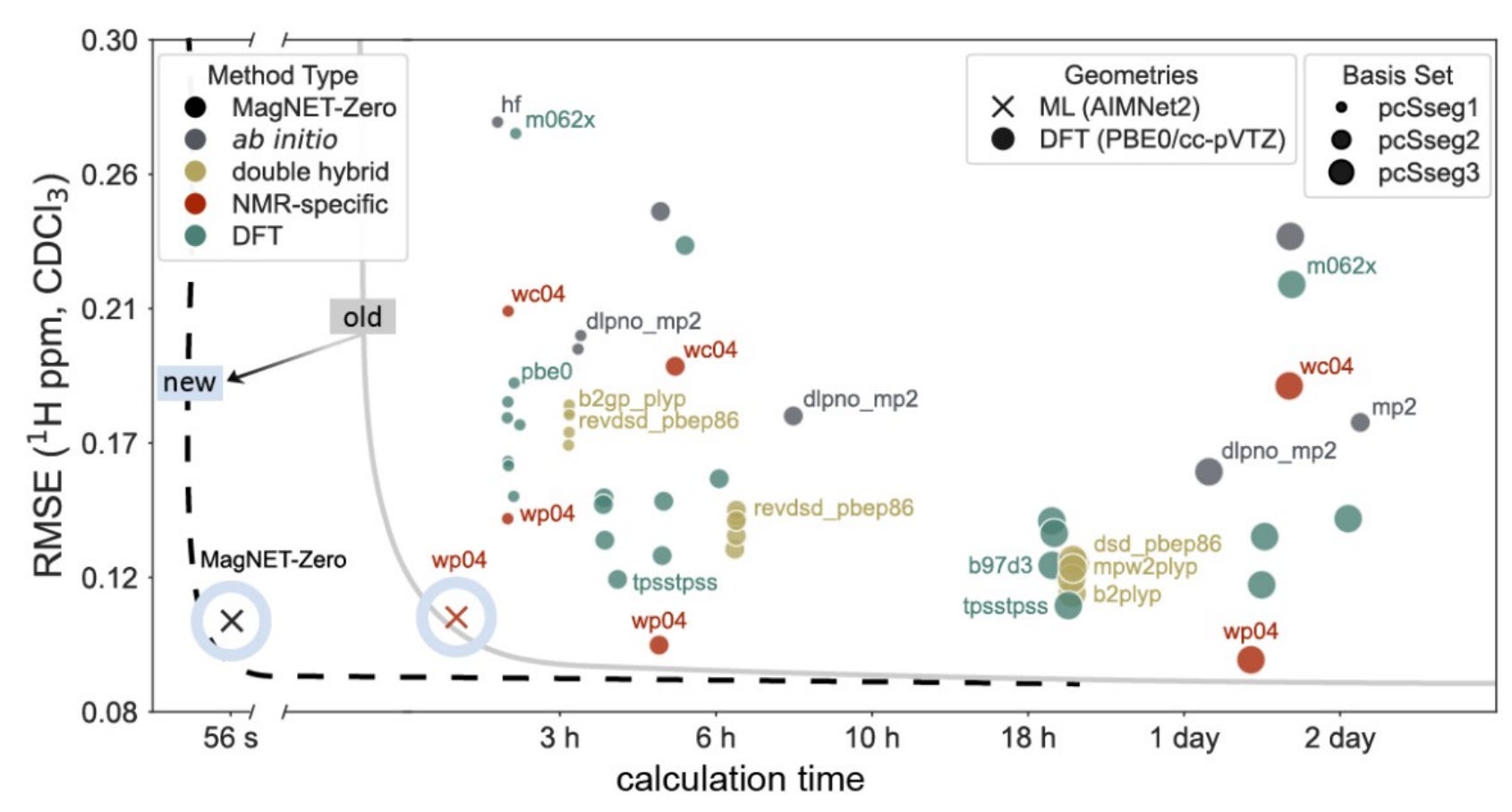
In practice, this means that MagNET is as good or better than DFT-based NMR predictions, while running orders of magnitude faster. On the delta-22 benchmark set, MagNET approaches the performance of quadruple-zeta basis sets and specialized NMR functionals, handily outperforming typical DFT methods:
MagNET is fast enough to be used in a variety of contexts which are prohibitively expensive for DFT-based NMR. Here’s two applications that we highlight in the paper:
MagNET can be used to model rovibrational corrections to NMR constants, which requires computing the NMR spectrum of many frames from a quasiclassical MD trajectory (see Kwan and Liu, 2015).
MagNET can also be used to model explicit-solvent corrections to NMR by modeling large solvent clusters derived from explicit-solvent MD trajectories. This produces noticeably better results for a variety of solvents, particularly aromatic solvents like benzene and toluene.
There’s a lot more to discuss here—why errors are flat across so many levels of theory, where remaining errors come from, how we trained this model, what’s in the dataset, and so on—but this blog is the wrong place! For more scientific details and discussions, see the preprint.
Predicting NMR Spectra in Rowan
MagNET-powered NMR predictions can be run in Rowan through the new NMR workflow. Users simply submit a chemical structure and a solvent; under the hood, Rowan runs a conformer search with openconf, deduplicates and optimizes the conformers with AIMNet2, and then computes solvent-corrected NMR shieldings for each conformer using MagNET. The final Boltzmann-weighted results are automatically plotted as 1H and 13C spectra, with symmetric protons combined. (Sadly, J-coupling constants aren’t computed.)
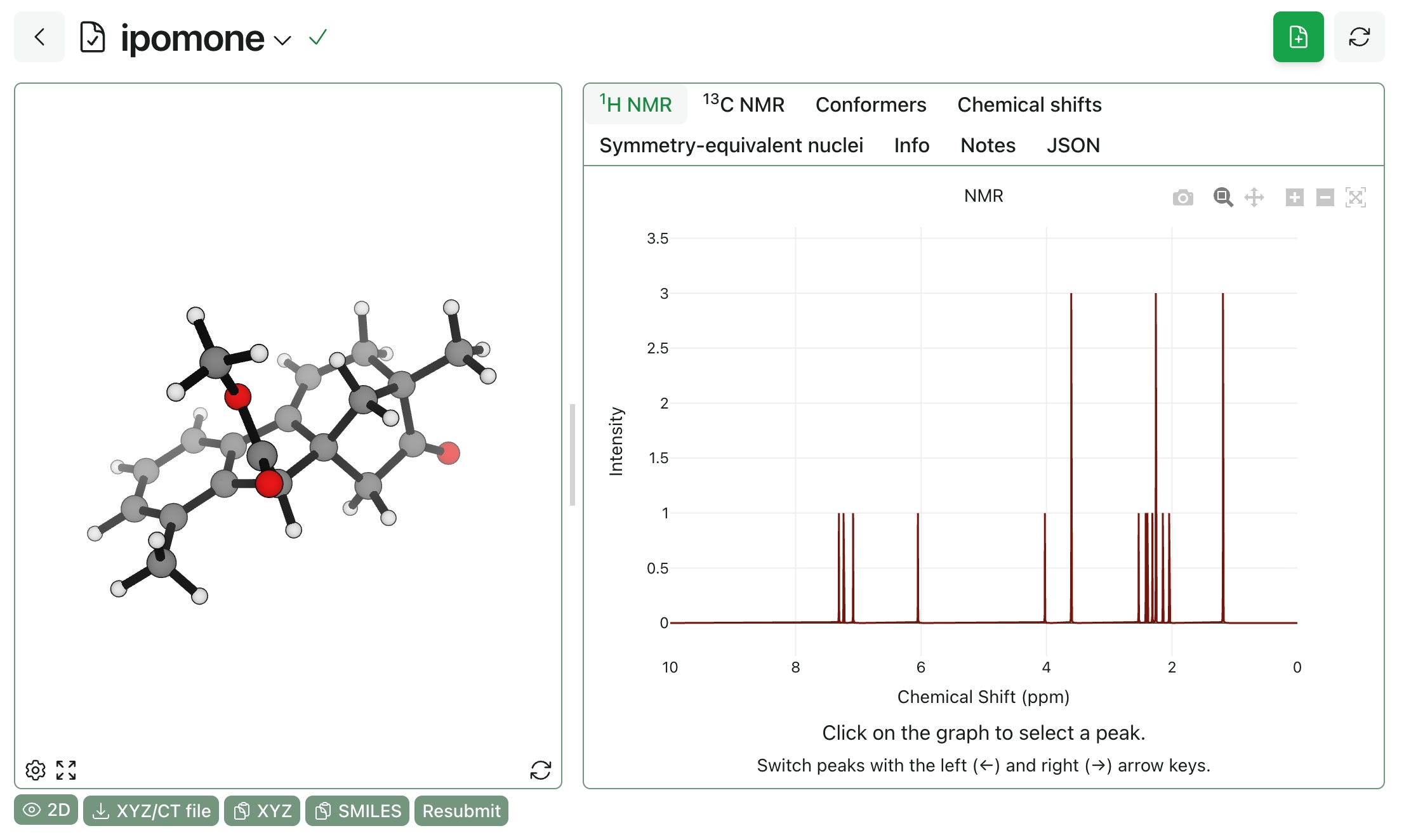
If you’re curious about what atoms generate a given peak, you can simply click on the peak on the spectrum and the corresponding atoms will be highlighted on the structure.
Rowan automatically includes solvent effects in the conformer weighting process and the subsequent NMR shieldings, making it possible to quickly predict how spectra will change between solvents. Here’s the predicted 1H NMR spectra of the common laboratory solvent DMA in both chloroform and benzene:
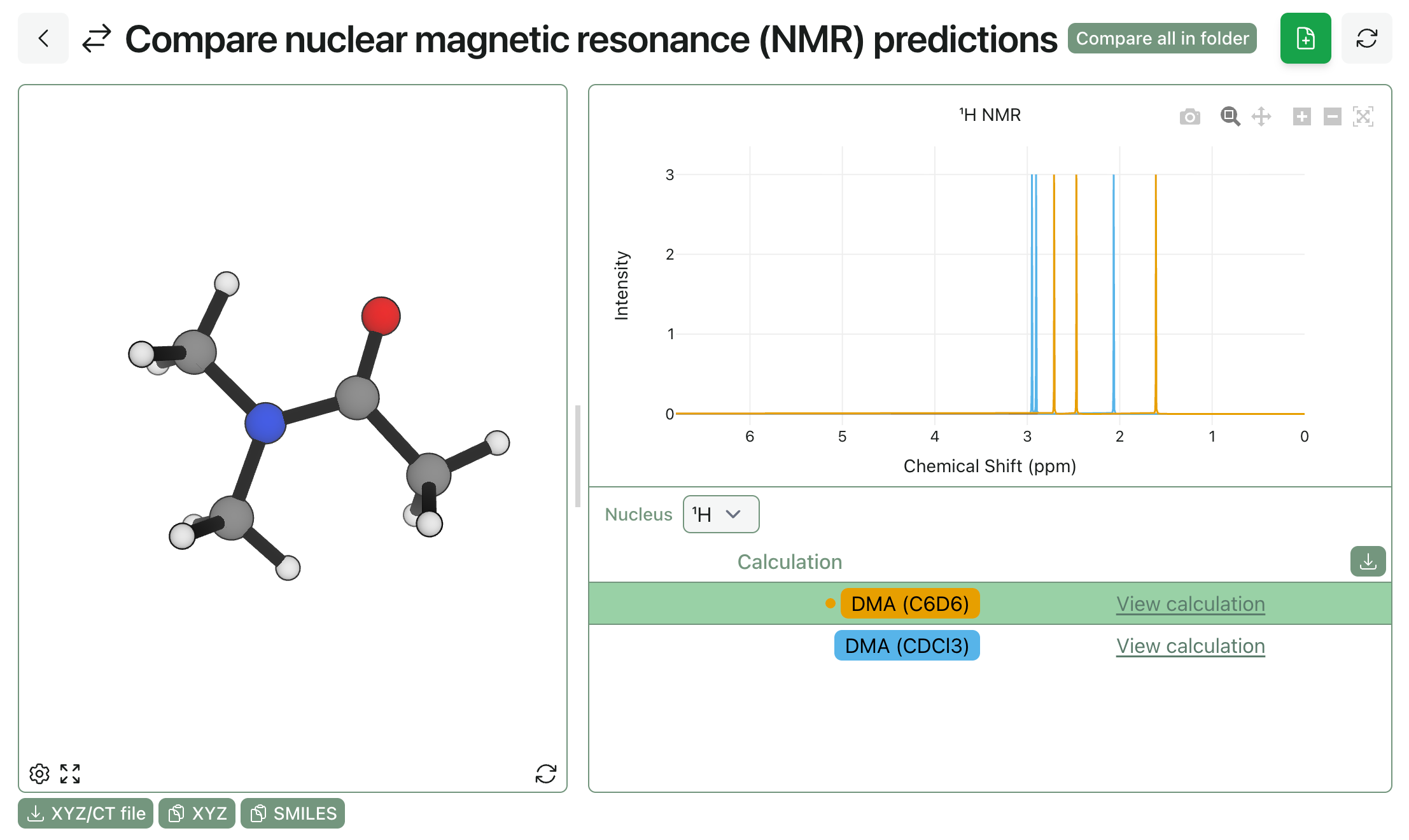
The computed shifts in both solvents match literature values well, and MagNET correctly predicts that the two methyl groups are better separated in benzene than in chloroform. If you find yourself with overlapping peaks in chloroform, consider predicting a few different solvents to find one that resolves the peaks! It’s faster (and less wasteful) than just trying different solvents.
Rowan’s NMR workflow is also good for more complex structure-elucidation tasks. One common use of NMR prediction is assignment of diastereomers; the popular CP3 method from Smith and Goodman involves computing the NMR shifts of all potential diasteromers and then comparing the experimental differences between shifts to computed differences between shifts.
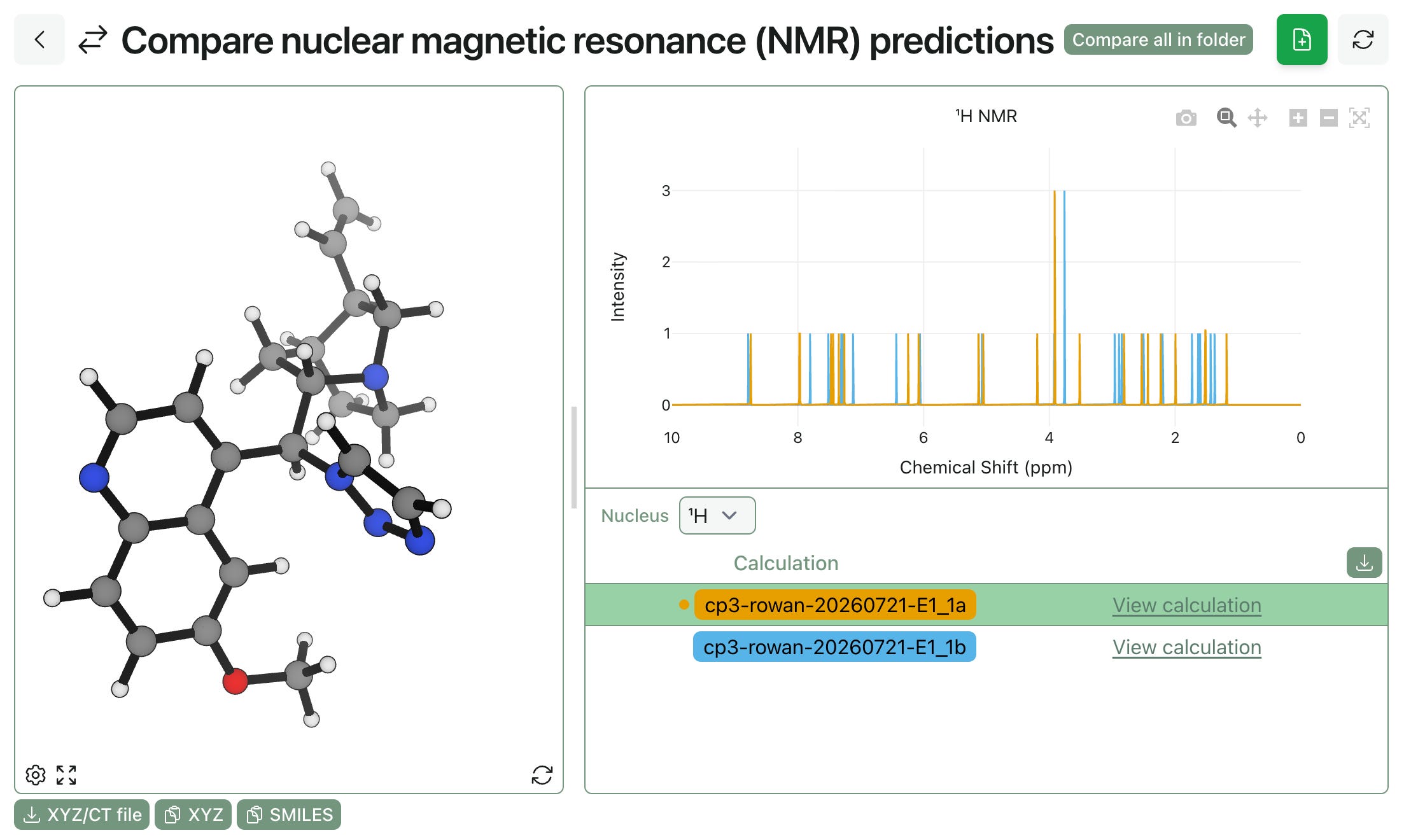
To test MagNET’s ability to distinguish diastereomers, we reproduced a published DFT-based CP3 assignment of cinchona alkaloid diastereomers (reference). Higher CP3 scores indicate better agreement; for the first spectrum in the paper, Rowan-predicted NMR shieldings gave a 1H CP3 score of 0.763 for the correct diastereomer (spectrum) and –0.901 for the incorrect diastereomer (spectrum), closely matching the published DFT values of 0.797 and –0.913 and clearly predicting the correct stereochemistry. Comparing the two NMR calculations makes the spectral differences obvious in Rowan:
Rowan’s NMR workflow takes just a minute or two and is immediately useful for laboratory chemists who regularly work with NMR spectra. Professor Michel Gravel from the University of Saskatchewan, one of our early NMR users, writes:
The NMR workflow in Rowan is very helpful for my research group. We routinely use it to ascertain the products of a reaction, to assign relative configuration, and to elucidate unknown structures. In our experience, the MAE is on par with the most accurate DFT methods. The workflow is so seamless and the interface so user-friendly that we have adopted it to complement our undergraduate lab experiments.
After years of work, we’re excited to finally release this to all Rowan users. We expect that NMR prediction will be routinely useful to a wide range of organic chemists, and we’re looking forward to seeing how easy access to high-accuracy NMR prediction can speed up their work or enable new projects. If you know an organic chemist who records NMR spectra regularly, consider telling them about Rowan!
Testing Rowan-Enabled Agents on DrugDiscoveryBench
Early this month, Scale Labs and Phylo released DrugDiscoveryBench, a benchmark designed to evaluate how well agents can perform early-stage drug discovery tasks. We ran a subset of this benchmark with Rowan-enabled agents, making use of our Python SDK and skill, to see how this would affect performance.
While our sample size was small, we found that Rowan tool use generally improved agents’ ability to successfully complete drug discovery tasks. Rowan-enabled agents also reached correct answers more consistently across repeated runs of the same task than agents relying on direct reasoning. The biggest pitfall was discoverability; agents with Rowan tools often used direct reasoning or ran crude local simulations instead of calling the relevant Rowan tool, which frequently led to a failed task
We’re excited to keep improving Rowan-agent integration to the make scientific agents more effective. If you would like to integrate Rowan with your agents, use our Python SDK, our skill, and please reach out to us! Read the full analysis on our blog.