



The best science happens in teams: a lab working through a hard target together, a chemist and a biologist trading ideas across a shared structure, or collaborators on different continents building on each other’s results. We want Rowan to be a place where that kind of work feels natural.
That’s why, in the coming days, every Rowan user will belong to an organization. Organizations give your team a shared home for projects, results, and ideas, with clear control over who can see and do what, so you can spend less time managing access and more time doing research together.
For most users, very little will change. If you’re already part of an organization, nothing will change; if you’re a free-tier user or an individual subscriber, your new organization will contain only yourself (unless you invite collaborators). We’re making these changes to create a more natural experience that better matches how scientists are already using Rowan, while allowing us to scale to meet the growing needs of our users. In this newsletter, we’ll explain what organizations in Rowan are, why organizations are useful, how this will impact existing Rowan users and API keys, and what this means for pricing.
What an organization is
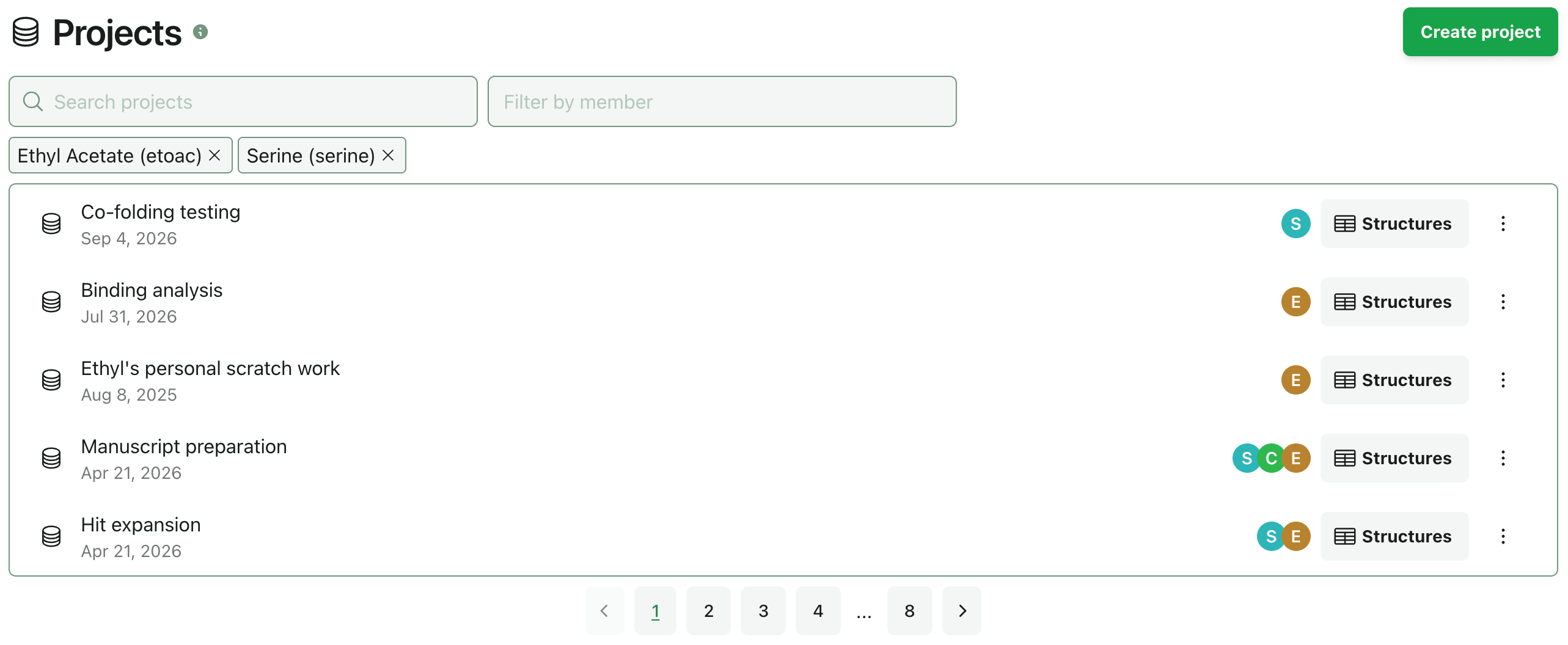
An organization is the workspace where your work lives. Each organization has its own projects, its own members, its own roles, and its own billing plan.
Projects still work the way they do today: they’re how you organize workflows, structures, and folders around a target, a paper, or a research direction. Organizations sit one level above projects. Every project belongs to an organization, and the people who can collaborate on a project are members of that organization.
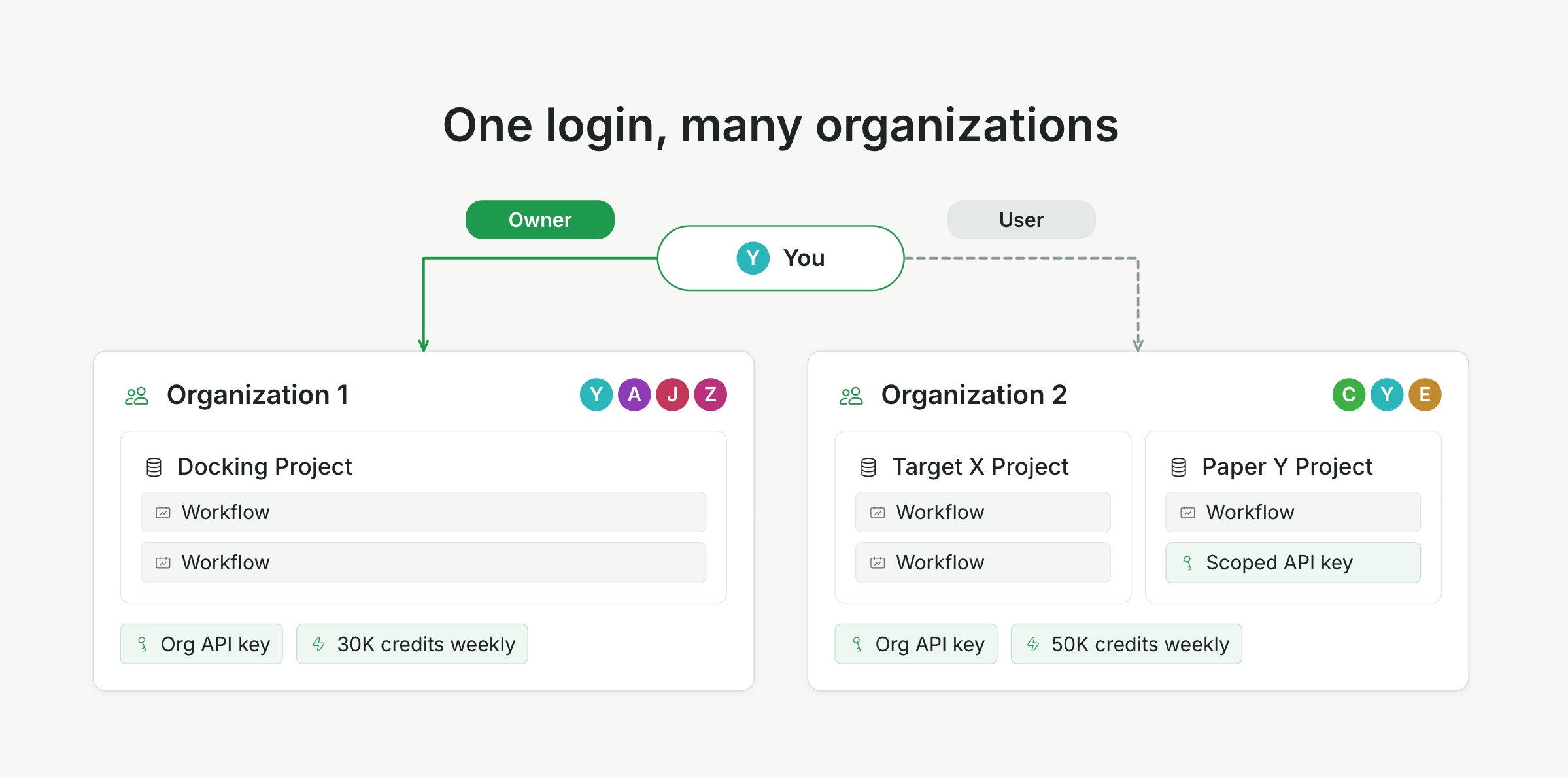
Your login stays personal. You’ll use the same account to sign in, and if you belong to more than one organization, you can switch between them without logging out. Your role is determined per organization, so you might manage your own group’s organization while being a regular member of a collaborator’s organization. For details on roles, permissions, and managing members, see our organization docs.
Why this is useful
Organizations give teams one shared place to work. Everyone’s projects live together, roles control who can run, edit, or just view calculations, billing is handled once for the group, and work stays with the organization when people come and go.
Organizations also help when your work spans more than one team, which is common—science rarely happens inside one neat box. Here are a few case studies where multiple organizations can help:
A postdoc in an academic lab collaborating with an industry partner. Their lab’s conformer searches and pKa predictions live in the lab’s organization; the joint docking and co-folding work on the partner’s target lives in a shared organization with the company’s chemists. The two sets of work stay separate, and the postdoc can move between them without a second account.
A computational chemist at a CRO supporting several clients. Each client engagement can be its own organization with its own members and plan, ensuring that structures and results from different programs stay separate. Team members can be added or removed as needed.
A PI who runs a group and also consults. The PI can manage the group’s organization, adding and removing students as they join and graduate, while keeping consulting work in a different organization with different collaborators.
Without organizations, the options are juggling multiple accounts or keeping unrelated work in the same place. Organizations make those boundaries explicit.
If you already use Rowan
You don’t need to do anything. Here’s what happens depending on how you use Rowan today:
If you use Rowan on your own for free, we’ll create a free, one-person organization for you and move your projects, credits, and API keys into it. You’ll have three seats, so you can invite a couple of collaborators whenever you like. If you work alone, day-to-day use stays the same: your organization is simply where your projects live.
If you have an individual subscription, we’ll do the same, and your subscription becomes a five-seat Team subscription at no extra cost. Your credits and subscription benefits carry over unchanged, and day-to-day use remains the same until you invite collaborators.
If you’re already part of a Rowan organization, nothing changes. Your work, members, and plan stay exactly where they are.
API keys
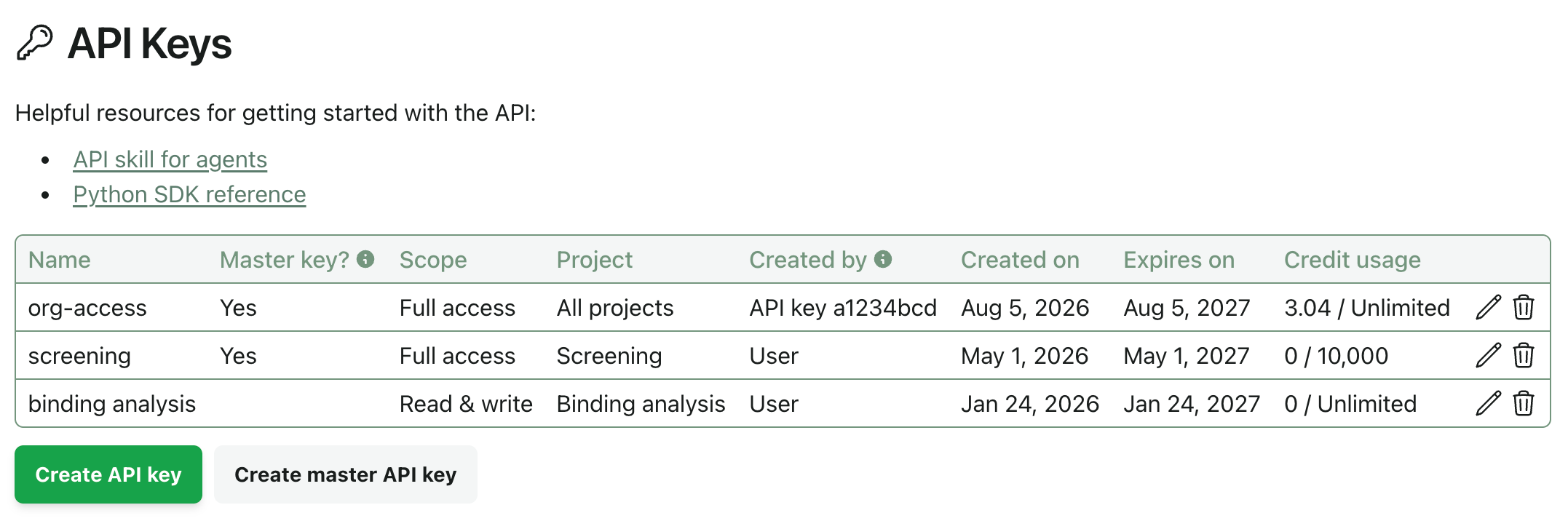
Existing API keys will keep working. You don’t need to replace them or change your scripts.
Going forward, all API keys will belong to a specific organization. Jobs submitted with a key run in that organization, which makes it clear where API work ends up when you’re a member of several organizations.
You can also optionally restrict a key to a single project within that organization. This is useful if you’re pointing a script or an agent at one project and want to make sure it can’t touch anything else—we recommend using project-scoped API keys where possible for agent-based work.
Pricing
Previously, only Rowan customers had access to organizations. Organizations can now be free or paid, making it easy to start small and grow as your team’s needs evolve.
Free is a good fit for trying Rowan out, lighter or occasional work, coursework, and early-stage collaborations. Free organizations, for both industry and academic users, include three seats and access to Rowan’s core workflows, so you can bring in a couple of collaborators without a subscription. You can create additional organizations whenever you need a separate space for a new project or client. Only the organization created with your account receives weekly free credits, but you can buy credits for any organization at any time.
Our Team offering is built for startups, academic labs, and small research groups running Rowan as part of their regular work. Team plans start at five seats and add:
Advanced workflows, including solvent-dependent conformers, macroscopic pKa, hydrogen-bond donor/acceptor strength, bond-dissociation energy, and pose-analysis MD
More credits and seats, sized to your team as it grows
Priority queuing, so your jobs start sooner when the platform is busy
Enterprise is designed for large organizations, pharma and biotech R&D groups, and teams with specific security, compliance, or deployment requirements. Enterprise plans can include free-energy perturbation, security and compliance documentation, single-tenant or customer-managed deployment, priority support via a private Slack channel, onboarding and training for your scientists, and extensive custom development.
Rowan aims to provide personal and customizable software to help your research, and our team is always happy to discuss pricing and find something that works for your use case. Contact us to talk about what your team needs.
Questions?
This is a structural change, and we’d rather hear about edge cases now than after the change is made. If you’re thinking about how organizations will fit your lab, company, or collaboration, or if something here is unclear, send us a note at contact@rowansci.com.